
Overview
Description
About
40th Floor 2-5-1 Atago Minato-ku
Tokyo, 105-6240
Latest press releases
BERLIN, April 16, 2026 /PRNewswire/ -- Appier, a leading AI Agent as a Service (AaaS) company transforming AdTech and MarTech through autonomous decisioning, announced its successful collaboration with Omio, a global travel booking platform, to expand user acquisition from Spain into a broad European presence within one year, consistently meeting CPA targets and maximizing ROI through Agentic AI-driven optimization.
As a pioneer in "multi-modal travel" Omio enables millions of travelers to compare and book trains, buses, flights, and ferries across more than 45 countries, supported by 2,000+ trusted transport partners and 28+ languages. Following strong performance in Spain, Omio set out to accelerate expansion across multiple new markets. The challenge was clear: scale efficiently across diverse regions while driving profitable first-purchase actions and maintaining strict CPA and ROAS discipline.
To support this ambition, Omio partnered with Appier's EMEA team to deploy its Ad Cloud solutions, including AIBID for ROAS-driven acquisition and Retargeting to enhance long-term value (LTV). At the core of the strategy was Agentic Incrementality, powered by Media Mix Modeling (MMM), which continuously measured the true causal impact of creative and inventory combinations against total sign-ups across markets.
Scaling First Purchases Across 21 Markets
Through always-on AI optimization, Omio consistently hit CPA targets while maintaining strong ROAS performance across expanding geographies. Within one year, the partnership evolved from a single-country initiative into a cross-border growth engine spanning Europe.
Unlike traditional campaign management approaches that rely on manual testing and pause-and-holdout experiments, Appier's Agentic AI dynamically adjusted creative formats and inventory placements in real time. High-incrementality traffic, such as rewarded and interstitial app placements, was scaled intelligently, while unhealthy traffic was automatically blocked, ensuring capital efficiency and eliminating wasted spend.
This real-time coordination enabled Omio to move beyond volume-based growth and focus on truly incremental, profitable user acquisition at scale.
A Three-Stage Creative Strategy to Balance Scale and ROI
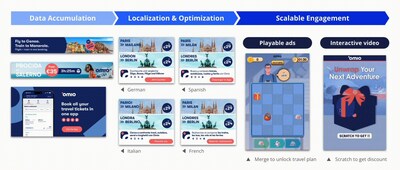
A key driver of Omio's success was its structured, three-stage creative strategy designed to balance rapid expansion with sustainable ROI:
1. Data Accumulation
Display ads were used to drive initial volume and gather foundational data for AI model learning, building the base for future optimization.
2. Localization & Optimization
Multi-language creatives were tested across European markets to identify high-performing segments. Insights revealed that localized Italian and French creatives significantly outperformed English versions, while German and Spanish markets showed a narrower performance gap. Winning incentives were then embedded into interactive formats.
3. Scalable Engagement
Playable ads and interactive video formats highlighted Omio's core value propositions, diverse transport options and cost-saving benefits, including scratch-to-get-discount mechanics that encouraged deeper engagement and improved conversion efficiency.
By combining localized creative insights with AI-powered optimization, Omio ensured each market received the right message at the right time, supporting both scale and profitability.
Unlocking Profitable Global Growth
Through continuous testing, iteration, and AI-driven automation, Omio successfully scaled first-purchase performance across its European expansion within one year, consistently meeting CPA targets and maximizing ROI.
"Working with Appier helped us scale efficiently into new markets while maintaining strong profitability," said Anastasiia Ivanova, App Performance Marketing Manager at Omio. "In just one year, our collaboration expanded from Spain to 21 countries, consistently meeting our CPA and ROAS goals. Appier delivers AI-powered data optimization, enhanced by expert insights, building strong, long-term partnerships that drive growth."
As Omio continues expanding globally, its collaboration with Appier demonstrates how Agentic AI-powered incrementality measurement and real-time optimization can enable high-quality, sustainable international growth in competitive digital markets.
About Omio
Omio is a leading global travel app that enables users to plan and book cross-border transportation by comparing and purchasing train, bus, flight, and ferry tickets in one place. Operating in more than 45 countries with over 2,000 trusted transport partners, Omio supports 28+ languages and multiple payment options, delivering a seamless travel experience for millions worldwide.
About Appier
Appier (TSE: 4180) is an AI-native Agentic AI as a Service (AaaS) company that empowers business decision-making with cutting-edge AdTech and MarTech solutions. Founded in 2012 with the vision of "Making AI Easy by making software intelligent," Appier endeavors to help businesses turn AI into ROI with its Ad Cloud, Personalization Cloud, and Data Cloud solutions. Now Appier has 17 offices across APAC, the US and EMEA, and is listed on the Tokyo Stock Exchange. Visit www.appier.com for more company information, and visit ir.appier.com/en/ for more IR information.

Photo - https://mma.prnewswire.com/media/2957058/image_5011078_37346483.jpg
Logo - https://mma.prnewswire.com/media/2688236/Appier_white_logo__blue_background_Logo.jpg
 View original content:https://www.prnewswire.co.uk/news-releases/omios-global-expansion-powered-by-appiers-agentic-ai-scaling-acquisition-across-21-markets-302743269.html

New Framework Boosts Reliability, Cost Efficiency, and Scalability for Enterprise AI
SINGAPORE, March 24, 2026 /PRNewswire/ -- As an AI-native Agentic AI-as-a-Service (AaaS) company, Appier today announced its latest research paper, On Calibration of Large Language Models: From Response to Capability, as part of its ongoing investment in advanced AI innovation. The study introduces Capability Calibration[1]—a new framework designed to address the overconfidence and hallucination challenges of large language models (LLMs) by enabling AI systems to better assess their own ability to solve a given task.
This research equips AI agents with a critical capability: estimating the likelihood of solving a problem before generating an answer. By introducing a quantifiable self-assessment mechanism, AI systems can make more reliable decisions and allocate computational resources more efficiently—improving the reliability, cost efficiency, and scalability of enterprise AI deployments.
From Response Accuracy to Problem-Solving Capability
Traditional LLM calibration focuses on response-level confidence, estimating whether a single generated answer is correct. However, because LLM outputs are inherently stochastic, the same query may produce different responses across multiple attempts. Therefore, a single response often fails to reflect the model's true capability.
In practice, organizations are less concerned with whether one answer is correct and more interested in whether a model can consistently solve the task. Appier's capability calibration framework addresses this by shifting evaluation from single-response confidence to the model's expected success rate for a given query. This moves the evaluation target from a single answer to the model's broader problem-solving capability, providing a more practical measure of real-world performance.
Teaching AI Agents to "Know Their Limits"
"AI agents should not only generate answers but also understand the limits of their own capabilities," said Chih-Han Yu, CEO and Co-Founder of Appier. "With capability calibration, an agent can estimate its probability of success before responding and allocate resources intelligently. Simple queries can be handled quickly, while complex tasks can automatically leverage stronger models or additional compute. This transforms AI from a passive tool into a system that actively manages resources, optimizes costs, and improves decision quality—an essential foundation for scaling enterprise-grade AI agents."
Experimental Results: High-Quality Calibration at Low Cost
The research clarifies the theoretical relationship between capability calibration and traditional response calibration[2], and evaluates multiple confidence estimation approaches across three large language models and seven datasets covering knowledge-intensive and reasoning-intensive tasks. Methods tested include:
- Verbalized confidence[3]: The model explicitly states its confidence, in text or as a percentage.
- P(True)[4]: Estimates the probability that the answer is correct based on generation signals.
- Linear probes[5]: Use internal model signals to assess whether it truly understands.
Results show that the linear probe method provides the best balance between cost and performance, with computational cost even lower than generating a single token while maintaining reliable confidence estimation.
Two Key Applications: Improving Inference Efficiency and Resource Allocation
The framework enables two practical use cases. First, pass@k[6] prediction, a widely used metric for evaluating LLMs in complex tasks. Capability-calibrated confidence estimates the probability that a model will produce at least one correct answer after k attempts, without actually generating multiple responses. Second, inference resource allocation, where computational resources are dynamically distributed based on predicted task difficulty. Harder problems receive more attempts, allowing more tasks to be solved within the same compute budget.
Building a Decision Foundation for Trustworthy AI Agents
Capability calibration enables AI agents to establish a stable and quantifiable confidence signal before taking action. This allows agents to determine whether they can solve a task independently, when to call external tools, and when to seek human assistance—helping AI systems operate more reliably in uncertain environments.
Advancing Capability Calibration to Power Agentic AI Applications
Looking ahead, Appier's AI research team will continue advancing capability calibration by improving model evaluation methods and expanding the framework to applications such as model routing, human–AI collaboration, and trustworthy AI systems. Leveraging Appier's deep expertise in AI and marketing technology, these research advances will be translated into product capabilities, accelerating the deployment of Agentic AI in advertising and marketing decision-making and helping enterprises operate more efficiently in an increasingly complex digital landscape.
About Appier
Appier (TSE: 4180) is an AI-native Agentic AI as a Service (AaaS) company that empowers business decision-making with cutting-edge AdTech and MarTech solutions. Founded in 2012 with the vision of "Making AI Easy by making software intelligent," Appier endeavors to help businesses turn AI into ROI with its Ad Cloud, Personalization Cloud, and Data Cloud solutions. Now Appier has 17 offices across APAC, the US and EMEA, and is listed on the Tokyo Stock Exchange. Visit www.appier.com for more company information, and visit ir.appier.com/en/ for more IR information.
[1] Capability Calibration – A method for evaluating an AI model's overall problem-solving ability by estimating the probability that it will successfully answer a given query, rather than judging a single response. |
[2] Response Calibration – A traditional AI evaluation approach that measures a model's confidence in the correctness of a single generated response. |
[3] Verbalized Confidence – A method where the model explicitly states its confidence in the correctness of an answer in natural language, such as a percentage or confidence level. |
[4] P(True) – A technique that estimates the probability that an answer is correct by analyzing the token probability distribution generated by the model. |
[5] Linear Probe – A lightweight linear classifier trained on a model's internal representations to analyze whether the model has learned specific knowledge or capabilities, and to estimate confidence. |
[6] pass@k – A common AI evaluation metric estimating the probability that a model produces at least one correct answer within k attempts, reflecting the need to explore multiple reasoning paths in complex tasks. |
For media queries, please email pr@appier.com
Logo - https://mma.prnewswire.com/media/2688236/Appier_white_logo__blue_background_Logo.jpg
 View original content:https://www.prnewswire.co.uk/news-releases/stop-ai-from-guessing-appier-enables-agents-to-assess-confidence-before-acting-302723087.html
