
Overview
Description
About
Yeongtong-gu
Suwon-si, 16677
Latest press releases
SEOUL, South Korea, June 26, 2026 /PRNewswire/ -- DEEPX, an on-device AI semiconductor pioneer, today announced that its ultra-low-power NPU technology is powering the Sixfab AI HAT+ for Raspberry Pi 5, a new edge AI acceleration board developed by Sixfab, an edge AI hardware solutions company and Official Raspberry Pi Design Partner.
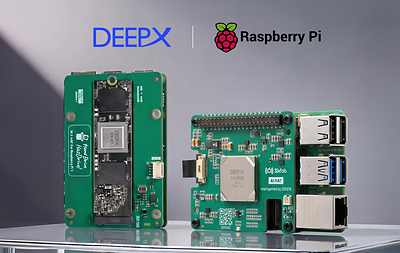
Marked as "Intelligentized by DEEPX," the product brings high-performance, low-power AI inference capabilities to the Raspberry Pi 5 ecosystem, enabling developers and enterprises to build real-time Physical AI applications at the edge.
'The DEEPX AI HAT' integrates DEEPX's proprietary NPU technology to run complex embedded AI models locally and in real time. It delivers an optimized balance of computational power and energy efficiency, enabling robust Physical AI inference in power-constrained environments such as robotics, smart agriculture, and factory automation.
"The DEEPX AI HAT offers our global community of enterprise developers and makers a highly efficient path to scale edge AI applications," said Roger Thornton, Director of Applications at Raspberry Pi.
To accelerate commercial adoption, DEEPX is rolling out a comprehensive developer package globally:
- Developer-Friendly SDKs: Software tools optimized for seamless model compilation and instant edge deployment.
"The future of Physical AI does not reside within a handful of data centers; it belongs to the billions of devices, robots, and industrial endpoints in the real world," said Lokwon Kim, CEO of DEEPX.
"By pairing Raspberry Pi's versatility with our low-power NPU, we aim to drive the democratization of Physical AI so that anyone can build and deploy advanced AI solutions." Kim added, "This launch is a cornerstone of our long-term strategy to cultivate future talent and developer ecosystems. DEEPX will expand collaborations with governments, academia, and industries worldwide to ultimately emerge as the definitive global standard platform for Physical AI."
The DEEPX AI HAT will soon be available worldwide through authorized distribution channels. Moving forward, DEEPX and Raspberry Pi anticipate further technical cooperation to elevate the platform as an enterprise-grade AI edge node.
About DEEPX
DEEPX is a leading on-device AI semiconductor company dedicated to democratizing Physical AI at the edge. Powered by its proprietary NPU architecture, DEEPX delivers high-performance, ultra-low-power solutions that enable edge devices to process sophisticated workloads—from real-time computer vision to on-device LLMs—locally. We empower industries, from robotics to smart cities, to unlock new possibilities with energy-efficient, secure, and cost-effective intelligence, visit www.deepx.ai.
About Raspberry Pi
Raspberry Pi is a global computer manufacturer delivering powerful and affordable computing platforms for industrial and embedded applications, makers, and education. Its world-class portfolio of single-board computers (SBCs), modules, microcontrollers, and integrated systems is supported by a comprehensive ecosystem of accessories, peripherals, and software. Together, they provide reliable, scalable solutions that power innovation across a broad range of industries. For more information, visit www.raspberrypi.com.
About Sixfab
Sixfab is an Edge AI Hardware Solutions company delivering rugged, connectivity-first hardware that brings real-time AI to the physical edge. As an Official Raspberry Pi Design Partner, Sixfab offers a off-the-shelf Edge AI development boards, production-ready edge AI computers, and custom design services for purpose-built systems. Together, Sixfab gives developers and enterprises a reliable, scalable path from prototype to global deployment across robotics, smart cities, and industrial automation. For more information, visit www.sixfab.com.
Official Channel
Hompage: https://deepx.ai/
Linkdin: https://www.linkedin.com/company/deepx-corp/
Youtube: https://www.youtube.com/@deepx2692/
 View original content to download multimedia:https://www.prnewswire.com/news-releases/deepx-and-sixfab-launch-deepx-ai-hat-to-drive-edge-physical-ai-on-raspberry-pi-302811587.html
SOURCE DEEPX

DEEPX NPU to be integrated across AAEON's full lineup of industrial computers, SBCs, and edge gateways — three-year mass production cooperation targeting smart factories, robotics, smart cities, and beyond
TAIPEI, June 2, 2026 /PRNewswire/ -- DEEPX Inc. (CEO Lokwon Kim), an ultra-low-power Physical AI semiconductor company, today signed a three-year Mass Production Cooperation MOU with AAEON Technology Inc. (TWSE: 6579, CEO Howard Lin), a leading provider of advanced industrial and embedded AI computing platforms, at COMPUTEX TAIPEI 2026. The signing ceremony took place at the DEEPX exhibition booth in Hall 1 of the Taipei Nangang Exhibition Center, with both CEOs in attendance.
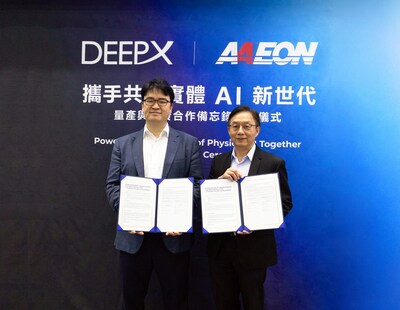
AAEON is one of Taiwan's foremost industrial computing companies, supplying industrial computers (IPC), embedded boards, and edge computing hardware to global markets. Under this agreement, the two companies will pursue a three-year commercialization cooperation to integrate DEEPX's AI semiconductors (NPU) across AAEON's key hardware product lines, including IPC, Single Board Computers (SBC), and edge gateways.
Going beyond a simple technology review, the core objective of this MOU is to embed DEEPX AI semiconductors into global industrial hardware product lines and scale them into commercially mass-producible products. The two companies have agreed to establish a mass production system for AI accelerator modules in standard form factors — M.2, mPCIe, PCIe cards, and COM Express boards — while also collaborating on OEM/ODM-based edge AI product development and large-scale production tailored to customer demand.
DEEPX will supply AI semiconductor chipsets and dedicated compiler and SDK support optimized for AAEON's product lines, while AAEON will lead hardware design, board form-factor specification matching, and the development of dedicated product lineups. Target sectors span smart factories and Industry 4.0, autonomous robots and AMR/AGV, smart cities, intelligent transportation, healthcare, retail, edge security, and smart agriculture.
This mass production agreement was made possible by the unrivaled business traction and commercial momentum that both companies have already demonstrated in global industrial environments. AAEON's next-generation industrial computing platforms — powered by DEEPX's production-ready semiconductors — secured initial pre-orders immediately following official certification in December 2025.
In particular, as ongoing mass-production verification with major global customers has validated exceptional power-to-performance ratios and system stability that exceed all expectations in real-world conditions, the transition from initial verification orders to large-scale commercial mass production and global scale-up is now well underway.
At COMPUTEX TAIPEI 2025, DEEPX had established a partner network of approximately 15 companies spanning Taiwan's industrial hardware landscape. One year on, that ecosystem has more than doubled — growing to over 30 partners globally — reflecting the accelerating industry demand for DEEPX's on-device AI semiconductor solutions across robotics, smart manufacturing, security, healthcare, and smart city applications.
The AAEON agreement adds significant new momentum to this trajectory: with AAEON's extensive global distribution channels, DEEPX gains substantially expanded market reach through a single strategic partnership. The two companies also plan to jointly pursue further market expansion at major global exhibitions including COMPUTEX, CES, and Embedded World, as well as through shared online and offline marketing channels.
"AAEON is the ideal partner, combining a globally proven hardware platform with the ASUS Group's extensive distribution network. With this mass production agreement, DEEPX will actively expand its presence in the global industrial market as a physical AI computing infrastructure company — delivering AI stably and efficiently inside the devices at the heart of industry." — Lokwon Kim, CEO, DEEPX Inc.
"DEEPX is setting a new standard in the edge AI market with an NPU architecture that perfectly balances power efficiency and high performance. Although DEEPX is one of our newer strategic partners, our collaboration has been exceptionally active and productive, driven by a deep alignment in addressing customer requirements for compact, low-power, and robust AI systems. By integrating AAEON's global hardware platforms with DEEPX's advanced semiconductor technology, we are well-positioned to deliver reliable, transformative edge AI solutions with long-term product availability across smart factories, healthcare, smart cities, and a wide range of industrial applications."— Howard Lin, CEO, AAEON Technology Inc.
About DEEPX Inc.
DEEPX Inc. is a South Korean fabless semiconductor company that adds intelligence to every electronic device through ultra-low-power, high-performance AI semiconductor technology. Based on its proprietary NPU architecture and DXNN SDK, DEEPX provides Physical AI infrastructure solutions across robotics, manufacturing, healthcare, security, and smart city sectors, and has secured more than 500 global patents. The company is engaged in mass production partnerships with Hyundai Motor & Kia, POSCO DX, LG U+, and Baidu, and is expanding its Physial AI ecosystem with over 50 global companies across the United States, Japan, Taiwan, and Europe.
About AAEON Technology
Established in 1992, AAEON is one of the leading designers and manufacturers of industrial IoT and AI Edge solutions. With continual innovation as a core value, AAEON provides reliable, high-quality computing platforms including industrial motherboards and systems, rugged tablets, embedded AI Edge systems, uCPE network appliances, and LoRaWAN/WWAN solutions. AAEON provides industry-leading experience and knowledge to provide OEM/ODM services worldwide. AAEON also works closely with cities and governments to develop and deploy Smart City ecosystems, offering individual platforms and end-to-end solutions. AAEON works closely with premier chip designers to deliver stable, reliable platforms. For an introduction to AAEON's expansive line of products and services, visit www.aaeon.com.
 View original content to download multimedia:https://www.prnewswire.com/news-releases/deepx-signs-global-edge-ai-mass-production-partnership-with-aaeon-at-computex-taipei-2026-302788287.html
SOURCE DEEPX
